
Accent · Sonoran native
Ocahui Agave
Agave ocahui · Asparagaceae (Agavoideae; formerly Agavaceae)
Also called: Ocahui, Amole, Amolillo
Ocahui Agave (Agave ocahui) is a very low-water accent native to the Sonoran Desert region well suited to Tucson and the low desert. It thrives in full sun, with a slow growth rate. Expect yellow blooms late spring to summer.
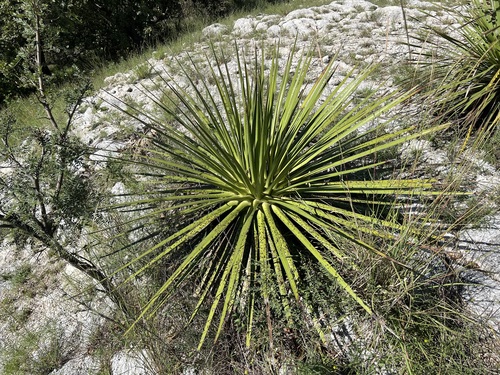
Ocahui Agave at a glance
- Water use
- Very Low (established)
- Sun
- Full sun; tolerates reflected heat. Also grows in light shade.
- Mature size
- 2-2.5 ft H x 2-3 ft W (rosette); flower stalk to 8-12 ft
- Growth rate
- Slow
- Bloom
- Yellow, Late spring to summer; monocarpic - the rosette dies after flowering. Typically solitary with few or no offsets.
- Cold hardiness
- Hardy to about 15-20 F; USDA zones 8-11. Cold-hardy in Tucson.
- Soil
- Excellent drainage required; thrives in rocky, gravelly, and sandy native desert soils. Tolerant of poor, lean soils.
- Native range
- Sonora, Mexico (Sonoran Desert and adjacent thornscrub/foothills). Native to the Sonoran Desert region.
- Best used as
- Accent / focal point, Small desert and xeriscape gardens, Container plant, Rock gardens, Mass plantings of matched symmetrical rosettes
- Wildlife
- Flowers provide nectar for bees, hummingbirds, and bats; supports native pollinators.
- Toxicity
- Sap contains saponins/oxalates that can irritate skin and eyes; the common names 'amole/amolillo' refer to its historical use as a soap. The terminal spine is sharp. Ingestion is irritating.
How to grow Ocahui Agave in Tucson & the low desert
Watering
Extremely drought tolerant once established; survives on Tucson rainfall. Occasional deep watering (every 3-4 weeks) in the hottest months improves appearance. No winter water.
Fertilizer & nutrients
Not needed; adapted to lean native soils. Fertilizing is unnecessary and not recommended - it can cause uncharacteristically soft, lush growth.
Pruning & care
Minimal. Remove only dead outer leaves and the spent flower stalk. Leaves have fine, fibrous (not sharp-toothed) margins and a single terminal spine - wear gloves.
Notes
A clean, symmetrical rosette of narrow, stiff, dark-green leaves with a distinctive reddish-brown or yellow-brown margin and fine, peeling marginal fibers (filaments) rather than teeth. Compact, tidy, and slow-growing - an excellent small-scale native accent for Tucson. Usually solitary, so a flowered plant is not replaced by offsets.
Sources: AMWUA 'Landscape Plants for the Arizona Desert'; University of Arizona Cooperative Extension; Arizona-Sonora Desert Museum; Tohono Chul / Tucson Botanical Gardens plant references