
Vegetable
Garlic
Allium sativum · Amaryllidaceae
Garlic (Allium sativum) is a moderate-water vegetable well suited to Tucson and the low desert. It thrives in full sun, with a slow growth rate.
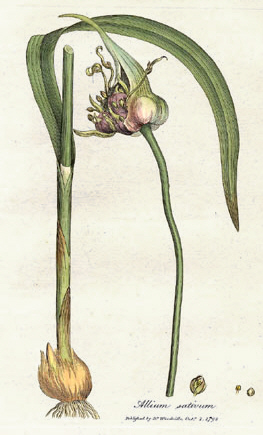
Garlic at a glance
- Water use
- Moderate (established)
- Sun
- Full sun (6+ hours).
- Mature size
- Tops 18-30 in tall; bulbs ~2-3 in across, splitting into cloves.
- Growth rate
- Slow
- Bloom
- Whitish to pink (true flowers rare; hardnecks send up a curling scape), Grown for bulbs; harvest late spring/early summer in Tucson (about 8-9 months after fall planting). Scapes form in spring on hardneck types.
- Cold hardiness
- Cool-season; very frost-hardy and overwinters easily in Tucson. SOFTNECK varieties generally perform best in the low desert's mild winters; many hardnecks want a colder vernalization than Tucson reliably provides.
- Soil
- Loose, well-drained, fertile loam high in organic matter; remove rocks and amend caliche so cloves bulb up cleanly. Tolerates slightly alkaline soils.
- Native range
- Central Asia; not native to the Sonoran Desert.
- Best used as
- Cool-season bulb vegetable, softneck types braid and store well, raised beds and in-ground rows, scapes (hardneck) as an early edible
- Wildlife
- Pungent foliage deters many browsers and pests; minimal direct wildlife value.
- Toxicity
- Edible and non-toxic to people. TOXIC to dogs and cats (Allium species cause hemolytic anemia, garlic being especially potent) - keep away from pets.
How to grow Garlic in Tucson & the low desert
Watering
Keep soil consistently moist during active leaf and bulb growth; in Tucson water deeply about every 2-3 days through winter and spring. Stop watering when lower leaves yellow and dry to let bulbs cure - excess late water causes rot and staining.
Fertilizer & nutrients
Nitrogen feeder during leaf growth - work compost into the bed and side-dress with nitrogen in late winter/early spring as tops grow, then stop before bulbing. Adequate phosphorus and potassium support bulb development.
Pruning & care
No pruning of leaves. On hardneck types, snap off the central flower stalk (scape) in spring to redirect energy into the bulb (scapes are edible). Softneck types (better suited to mild-winter Tucson) usually don't produce scapes.
Notes
In Tucson plant individual cloves (pointed end up) in fall, roughly Oct-Nov, for harvest the following late spring/early summer. Favor softneck (and some intermediate) varieties suited to mild winters. Harvest when about half the lower leaves have browned; cure bulbs in a dry, shaded, airy place before storing. Mulch helps conserve moisture and moderate soil temperature.
Sources: University of Arizona Cooperative Extension (Pima County) low-desert vegetable planting calendar; Pima County Master Gardeners; Arizona Master Gardener Manual