
Tree
Bottle Tree
Brachychiton populneus · Malvaceae
Also called: Kurrajong, Australian Bottle Tree
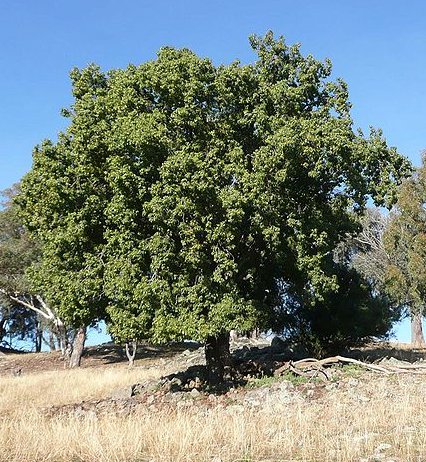
Bottle Tree (Brachychiton populneus) is a low-water tree well suited to Tucson and the low desert. It grows to 30-45 ft tall, 25-30 ft wide in full sun, with a slow to moderate growth rate.
Bottle Tree at a glance
- Water use
- Low (established)
- Sun
- Full sun; tolerates reflected heat once established.
- Mature size
- 30-45 ft tall, 25-30 ft wide
- Growth rate
- Slow to moderate
- Bloom
- Creamy white to pale yellow, bell-shaped (often partly hidden in foliage), Late spring to early summer (May-June)
- Cold hardiness
- Hardy to about 18-20°F; well suited to Tucson winters with little to no frost damage in zones 9a-9b.
- Soil
- Adaptable to most well-drained desert soils, including alkaline and rocky soils; tolerates clay if drainage is adequate.
- Native range
- Eastern Australia
- Best used as
- Shade tree, Evergreen screen, Street/parkway tree, Low-water landscape specimen
- Wildlife
- Flowers attract bees; provides nesting and cover for birds. Not a strong pollinator magnet but useful structural habitat.
- Toxicity
- Seeds are surrounded by fine irritating hairs inside the boat-shaped pods that can cause skin/eye/throat irritation; keep curious children and pets away from opened pods. Not a major systemic poison.
How to grow Bottle Tree in Tucson & the low desert
Watering
Water deeply but infrequently to establish (every 7-10 days the first summer); established trees thrive on deep monthly irrigation in summer and every 4-6 weeks in winter. Drought tolerant once rooted.
Fertilizer & nutrients
Generally needs little to no fertilizer in desert soils; a light application of balanced or slow-release tree fertilizer in early spring if growth is sluggish. Apply micronutrients (iron/zinc) only if chlorosis appears.
Pruning & care
Prune in late winter to early spring to develop a strong central leader and remove crossing or weak branches; minimal pruning needed once structure is established.
Notes
Reliable evergreen shade tree for the low desert with a distinctive swollen (bottle-shaped) trunk base on older specimens. Dense canopy and strong wood make it more wind- and storm-resistant than many fast-growing desert trees. Drops pods that should be cleaned up. Plant in spring or fall.
Sources: University of Arizona Cooperative Extension / Pima County Master Gardeners; Arizona-Sonora Desert Museum plant references; AMWUA Landscape Plants for the Arizona Desert