
Citrus
Washington Navel Orange
Citrus x sinensis 'Washington Navel' · Rutaceae
Also called: Navel Orange, Bahia Orange
Washington Navel Orange (Citrus x sinensis 'Washington Navel') is a moderate-water citrus well suited to Tucson and the low desert. It thrives in full sun, with a moderate growth rate. Expect white blooms Fragrant white blooms in spring.
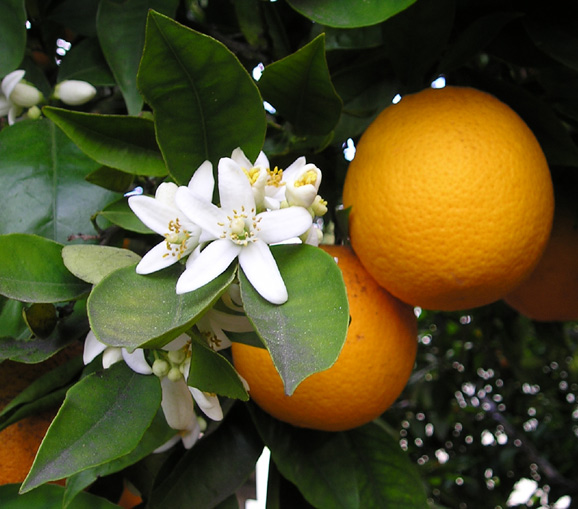
Washington Navel Orange at a glance
- Water use
- Moderate (established)
- Sun
- Full sun (6+ hours). In Tucson, give some protection from intense late-afternoon western sun on young trees, and never plant against a hot reflective west-facing wall.
- Mature size
- 18-22 ft tall and wide on standard rootstock; 8-12 ft on dwarf/semi-dwarf. Commonly kept 12-15 ft in home landscapes.
- Growth rate
- Moderate
- Bloom
- White, Fragrant white blooms in spring (March-April); fruit harvest mid-November through February-March.
- Cold hardiness
- USDA 9a-9b. Sweet oranges are damaged below about 26-28 F; fruit can be injured by hard frosts. Marginal in Tucson's coldest low spots; plant where cold air drains away (slopes) and protect young trees.
- Soil
- Well-drained native or amended desert soil; tolerates the alkaline, low-organic conditions of Tucson but will not tolerate standing water or poor drainage. Plant on a slight mound in heavy or caliche soils.
- Native range
- Cultivar; sweet orange (C. x sinensis) is a hybrid of Asian origin, the Washington Navel selection arising in Bahia, Brazil and introduced to the U.S. in the 1870s.
- Best used as
- Fresh eating, Edible landscape / fruit tree, Shade and ornamental specimen, Pollinator (bee) forage
- Wildlife
- Spring flowers attract honeybees and native pollinators; fruit eaten by birds and javelina if it falls.
- Toxicity
- Fruit is edible and safe for people. Foliage, peel oils, and seeds contain compounds (essential oils, psoralens) considered toxic to dogs, cats, and horses if eaten in quantity; thorns can scratch.
How to grow Washington Navel Orange in Tucson & the low desert
Watering
Deep, infrequent irrigation to the bottom of the root zone (about 3 ft): roughly every 7-10 days in summer, every 2-3 weeks in spring/fall, and every 4-6 weeks in winter. Water out at the canopy dripline, not at the trunk, and let the top few inches dry between waterings.
Fertilizer & nutrients
Nitrogen-hungry: apply about 1-1.5 lb actual N per year to a mature tree, split in three feedings (Jan-Feb, Mar-Apr, May-Jun). Skip late-summer/fall nitrogen so tender growth hardens before frost. Watch for iron/zinc/manganese chlorosis in Tucson's alkaline soil and correct with chelated micronutrient foliar sprays.
Pruning & care
Minimal. Remove deadwood, crossing branches, and below-graft suckers; thin lightly only to shape. Best pruned just after harvest in late winter to early spring. Keep lower skirts and interior shaded to prevent sunburn on bark.
Notes
Premier fresh-eating navel: seedless, easy to peel, sweet. Self-fruitful (no pollinizer needed). In Tucson plant October-March, ideally fall, in a warm microclimate with cold-air drainage; protect trunks of young trees from sunburn (white latex paint or trunk wrap) and cover during hard freezes. Does not store on the tree as long as Valencia.
Sources: University of Arizona Cooperative Extension az1850 'Oranges for Southern Arizona' (G. Wright); University of Arizona Cooperative Extension az1001 'Low Desert Citrus Varieties'; University of Arizona Cooperative Extension 'Citrus Fertilization Chart for Arizona'; AMWUA Landscape Plants for the Arizona Desert