
Vine
Lavender Trumpet Vine
Clytostoma callistegioides · Bignoniaceae (trumpet-creeper family)
Also called: Violet Trumpet Vine, Yellow Trumpet Vine (trade misnomer), Argentine Trumpet Vine, Bignonia callistegioides, Bignonia violacea
Lavender Trumpet Vine (Clytostoma callistegioides) is a moderate-water vine well suited to Tucson and the low desert. It thrives in full sun to part shade, with a fast growth rate.
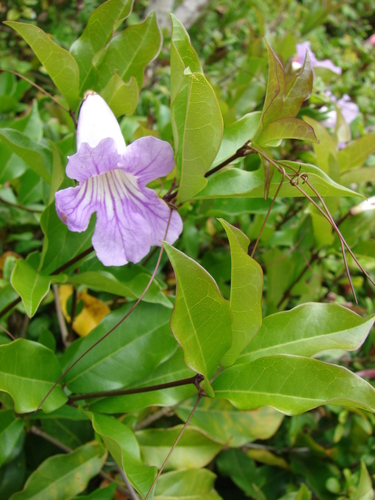
Lavender Trumpet Vine at a glance
- Water use
- Moderate (established)
- Sun
- Full sun to part shade; flowers most heavily in full sun but appreciates protection from intense Tucson reflected afternoon heat.
- Mature size
- 20-30 ft H x 15-20 ft W (evergreen woody vine climbing by tendrils)
- Growth rate
- Fast
- Bloom
- Large lavender to lilac-blue tubular trumpet flowers with violet veining and a pale yellow/white throat, Spring through fall, heaviest in spring and early summer
- Cold hardiness
- Hardy to about 15-20°F (USDA zone 8-10); may suffer leaf burn or partial dieback in a hard Tucson freeze but generally evergreen and recovers.
- Soil
- Well-drained soil enriched with organic matter; tolerates alkaline desert soil but performs best in amended ground with good drainage.
- Native range
- Southern Brazil and Argentina
- Best used as
- Evergreen screen/cover for walls, fences, arbors, and trellises, Shade and privacy on patios, Ornamental flowering vine
- Wildlife
- Tubular flowers attract hummingbirds and bees/pollinators.
- Toxicity
- No significant toxicity reported; generally regarded as safe in the landscape.
How to grow Lavender Trumpet Vine in Tucson & the low desert
Watering
Needs regular irrigation for best performance in the low desert: deep watering 1-2 times per week in summer heat. Drought-stressed plants drop foliage and bloom poorly.
Fertilizer & nutrients
Benefits from regular feeding: apply a balanced fertilizer in early spring and again after the first bloom flush to sustain flowering and dense evergreen foliage. Iron chelate corrects occasional chlorosis in alkaline soil.
Pruning & care
Prune after the main spring bloom to shape and control size; thin tangled growth and remove dead wood. It blooms on new growth, so periodic pruning encourages reblooming.
Notes
Despite the occasional 'yellow trumpet vine' label, the flowers are lavender/violet (the yellow appears only as a throat tint). Surprisingly well adapted to the low desert if given ample water; evergreen in mild winters. Provide a sturdy support for its heavy mature growth.
Sources: Arizona State University (Christine Martin) Desert Landscape Plant database; AMWUA Landscape Plants for the Arizona Desert / regional vine references; San Marcos Growers; Monrovia plant database; Civano Nursery (Tucson) plant catalog