
Shrub
Chihuahuan sage
Leucophyllum laevigatum · Scrophulariaceae
Also called: Chihuahuan rain sage, smooth-leaf ranger, Chihuahuan ranger
Chihuahuan sage (Leucophyllum laevigatum) is a very low-water shrub well suited to Tucson and the low desert. It grows to 4-5 ft H x 4-6 ft W in full sun, with a slow to moderate growth rate. Expect lavender to violet-purple blooms summer into fall, flushing after monsoon rains and humidity spikes.
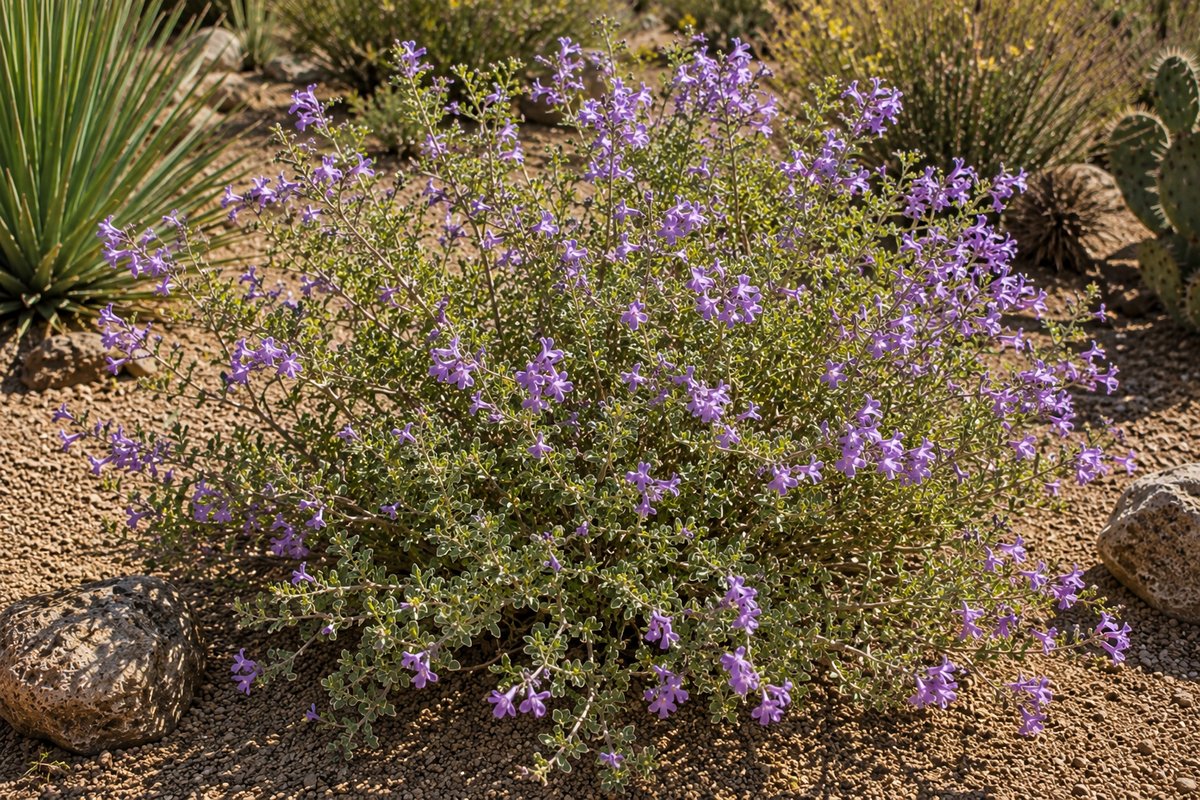
Chihuahuan sage at a glance
- Water use
- Very Low (established)
- Sun
- Full sun; tolerates reflected heat. Gets leggy and sparse in shade.
- Mature size
- 4-5 ft H x 4-6 ft W
- Growth rate
- Slow to moderate
- Bloom
- Lavender to violet-purple, Summer into fall, flushing after monsoon rains and humidity spikes (July-October), with scattered bloom spring-fall
- Cold hardiness
- Hardy to about 10-15°F; USDA zones 8-11
- Soil
- Requires excellent drainage; tolerates poor, rocky, alkaline, calcareous desert soils. Will not tolerate wet or heavy clay soils.
- Native range
- Chihuahuan Desert of north-central Mexico (Chihuahua, Coahuila, Zacatecas)
- Best used as
- Low-water foundation and accent shrub, Informal hedge or screen, Mass planting, Desert and xeriscape gardens, Median and parking-lot plantings
- Wildlife
- Flowers attract native bees, butterflies, and some hummingbirds; provides cover for small birds
- Toxicity
- Not known to be toxic to humans, pets, or livestock
How to grow Chihuahuan sage in Tucson & the low desert
Watering
Deeply but very infrequently once established; in Tucson, water established plants every 2-3 weeks in summer and monthly or less in winter. Overwatering and poor drainage cause root rot and dieback, the most common cause of failure.
Fertilizer & nutrients
Essentially none required; thrives in lean desert soils. Avoid fertilizer, which promotes weak, leggy growth.
Pruning & care
Avoid shearing, which ruins the natural open form and causes woody dead zones; instead thin selectively or cut back hard in late winter/early spring only if rejuvenation is needed. It blooms on new growth, so light spring tip-pruning encourages density.
Notes
One of the more open and airy Leucophyllum species with smooth (laevigatum = 'smooth') gray-green leaves; less dense than L. frutescens. Drought- and heat-loving; the most frequent killer in Tucson is overwatering combined with poor drainage. Sometimes confused with other 'Texas ranger' / 'sage' Leucophyllums but is a true smaller, finer-textured species.
Sources: AMWUA Landscape Plants for the Arizona Desert; Arizona-Sonora Desert Museum; University of Arizona Cooperative Extension; Tohono Chul / Tucson Botanical Gardens