Accent · Sonoran native
Banana Yucca
Yucca baccata · Asparagaceae (Agavoideae)
Also called: Datil, Datil Yucca, Blue Yucca, Spanish Bayonet
Banana Yucca (Yucca baccata) is a very low-water accent native to the Sonoran Desert region well suited to Tucson and the low desert.
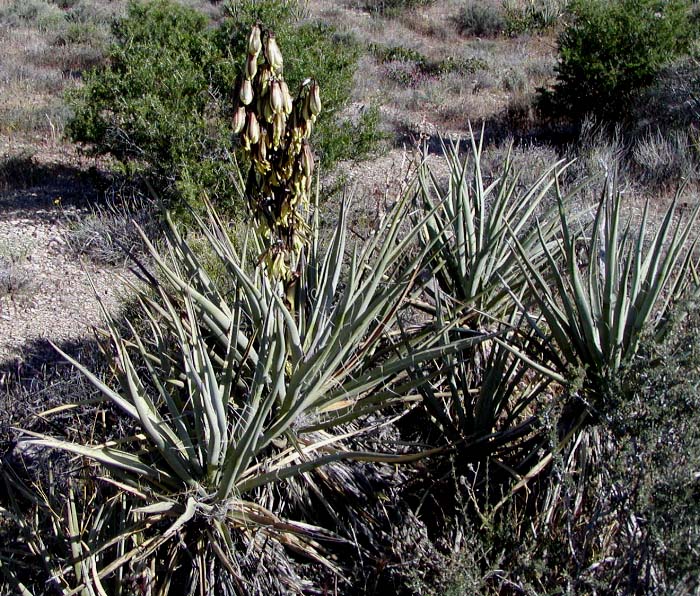
Banana Yucca at a glance
- Water use
- Very Low (established)
- Sun
- Full sun to light/filtered shade; very tolerant of reflected heat and also of part shade beneath desert trees.
- Mature size
- 2-4 ft H x 3-5 ft W rosette (trunkless or short-trunked); flower stalk to about 3-4 ft, usually held within or just above the foliage.
- Growth rate
- Slow.
- Bloom
- Large, fleshy, bell-shaped flowers, white to cream often flushed with purple/brown on the outside., Spring to early summer, roughly April-July.
- Cold hardiness
- Very cold hardy, to about 0°F and lower (reported to -20°F); USDA zones 5-10.
- Soil
- Well-drained rocky, gravelly, or sandy desert soils; tolerates caliche and alkalinity. Excellent drainage required.
- Native range
- Native to the Sonoran, Mojave, and Chihuahuan deserts and surrounding uplands of Arizona, New Mexico, Texas, Colorado, Utah, Nevada, California, and northern Mexico; native to Arizona.
- Best used as
- Low to mid-height accent and specimen, Native and wildlife/habitat gardens, Understory accent beneath desert trees, Xeriscape and rock gardens, Edible-fruit/heritage plantings
- Wildlife
- Pollinated by yucca moths; the fleshy 'banana' fruit and flowers are eaten by wildlife (and historically a prized human food, baked like a sweet potato); roots yield soap (amole). Provides cover for small animals.
- Toxicity
- Low toxicity to humans; fruit, flowers, and emerging stalks are edible. Roots/leaves contain saponins (mild GI irritant if ingested raw in quantity) and the leaf tips are dangerously sharp; keep away from foot traffic.
How to grow Banana Yucca in Tucson & the low desert
Watering
Highly drought tolerant once established; supplemental water only every 3-4 weeks in peak summer heat and essentially none in cooler months. Tolerates more shade and slightly more water than soaptree yucca but still resents wet feet.
Fertilizer & nutrients
None needed in native soils. Mature plants are not fertilized; young plants can take one light spring application of slow-release fertilizer to aid establishment if growth is slow.
Pruning & care
Very low; remove old flower/fruit stalks and trim dead outer leaves. Leaves are stiff and sharply tipped, so handle with care. No shearing.
Notes
Distinguished by broad, thick, stiff, blue-green to dark-green strap-like leaves with coarse curling marginal fibers, and by its large pendent fleshy edible fruit ('baccata' = berry-like). Usually clumping and trunkless or with a short reclining trunk. One of the most cold-hardy and shade-tolerant desert yuccas.
Sources: AMWUA – Landscape Plants for the Arizona Desert (Banana Yucca profile); Arizona-Sonora Desert Museum 'Banana Yucca or Datil' care sheet; University of Arizona Cooperative Extension; Arizona-Sonora Desert Museum 'Genus Yucca' / Natural History of the Sonoran Desert